


Pickleball Court Line Width
Pickleball Court Line Width: The Invisible Ruler Defining Precision on the Court
On a Pickleball court, line markings serve as silent yet indispensable referees, their precisely measured widths guiding the rhythm and accuracy of every rally.
Though they may appear simple and understated, these lines are essential to ensuring fairness, clarity, and competitive integrity. Their width standards reflect thoughtful design, sports science, and an understanding of how players interact with the court.
Boundary Lines: 2–3 Inches — Clear, Visible, and Purposefully Calibrated
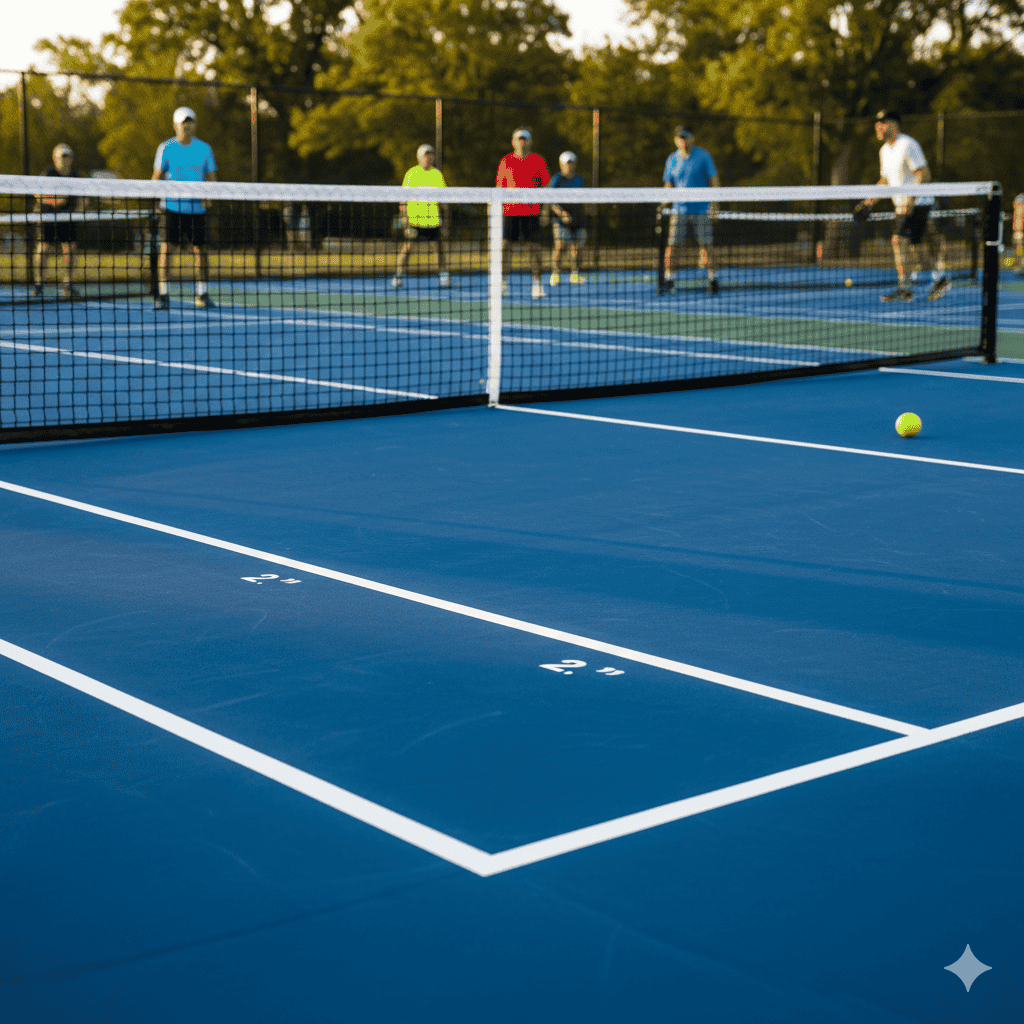
The boundary lines on a Pickleball court typically measure 2–3 inches (≈5–7.6 cm) in width.
This range is not arbitrary—it's carefully designed to provide clear visual definition without overwhelming the field of play. During fast-paced matches, players must continually assess the ball’s proximity to the sidelines. A line that is wide enough ensures accurate judgment, helping both players and referees determine whether a ball is “in” or “out.”
Yet tBHI Pickleball -Custom Pickleball Paddlehe boundary lines are not so wide that they distract players or interfere with concentration. This balance ensures maximum clarity while preserving an unobstructed playing environment. In competitive settings, where a single point can determine the outcome, these precisely defined lines play a critical role in keeping the match fair and decisive.
Service Line: 1–2 Inches — The Technical Guide for Every Serve
The service line, typically 1–2 inches (≈2.5–5 cm) wide, is vital for regulating the serve—the opening action of every point.
A narrower width increases the demand for precision, requiring servers to demonstrate excellent control and accuracy. The clear markings help servers understand exactly where the ball must land, ensuring compliance with the rules. At the same time, this clearly defined service line enables receivers to anticipate shot direction, judge depth, and prepare their response in advance.
Each serve becomes a miniature strategic battle played along this carefully measured line. The server strives to place the ball precisely while generating speed and pressure, while the receiver seeks to read the serve effectively and initiate the point from a position of advantage.
Doubles Sidelines: 2–3 Inches — Clear Boundaries for Coordinated Team Play
The doubles sidelines—usually 2–3 inches (≈5–7.6 cm) wide—define the extra width used in doubles play.
In the dynamic environment of a doubles match, players move rapidly, rallies are frequent, and ball trajectories become more unpredictable. Clear doubles sidelines ensure that teams can accurately judge the ball’s landing spot amidst fast-paced exchanges.
These lines also help players establish proper positioning and spacing. Teams must coordinate movements based on sideline placement, ensuring they cover angles effectively while avoiding unnecessary gaps. Strategically, the area near the doubles sideline becomes a valuable zone—ideal for sharp passing shots, precise volleys, and coordinated offensive plays aimed at stretching the opponents’ formation.
Center Line: 1–2 Inches — The Axis of Structure and Strategy
The center line, typically 1–2 inches (≈2.5–5 cm) wide, evenly divides the service area and plays a key role in positioning and tactical planning.
In serving situations, the center line ensures that players deliver the ball to the correct service box. Throughout the rally, the line helps players maintain positional balance, guiding movement patterns and helping prevent overextension.
In singles, players use the center line to manage court coverage efficiently, maintaining optimal positioning to defend both left and right sides.
In doubles, the center line becomes even more critical—partners rely on it to coordinate coverage, divide responsibilities, and maintain an organized defensive structure.
The Silent Framework of Fairness and Precision
Together, these carefully measured lines form the standardized structural framework of every Pickleball court.
Like invisible rulers, they quietly regulate every shot, movement, and strategic decision. Their presence ensures that matches—whether elite-level tournaments or casual weekend games—are conducted under consistent, impartial standards.
These lines reflect the sport’s commitment to fairness and precision. They witness every spectacular rally, every decisive point, and every athlete's growth on the court. When players step onto the Pickleball court, the crisp, precisely drawn lines beneath their feet serve as a reminder of the sport’s discipline, clarity, and enduring spirit.
Let us respect these standards and, within the boundaries they define, write our own Pickleball stories—full of passion, determination, and unforgettable moments.
BHI Pickleball -Custom Pickleball Paddle


